
Managing Multiple Mining Accounts From One App
Three accounts holding 200 TH/s, 500 TH/s and 1 PH/s produce about 0.000763 BTC — roughly $64.59 — a day at current difficulty, or 0.0000318 BTC an hour. The arithmetic is simple; the operations are not, because that total is spread across separate logins, separate alert settings and separate withdrawal addresses. Consolidating the view is what turns three balances into one decision.

Key takeaways
- 200 TH/s, 500 TH/s and 1 PH/s together yield 0.000763 BTC a day — $64.59 at $84,692 — and 0.0000318 BTC every hour under PPS+.
- Each account carries its own 2FA, session list and withdrawal address, so three logins triple the surfaces a monthly review has to cover.
- Per-site baselines beat farm-wide thresholds: one machine of twelve failing moves a combined total by only about 8%.
- Multi-account management exists to keep monitoring in one place — not to merge settlements, which stay per account unless you deliberately consolidate.
Why the numbers move
Running several accounts is rarely a preference; it is usually a consequence. A hosting contract settles under its own login. A second site gets its own account so its hashrate can be reconciled independently. A solo-mining experiment gets a third. Six months later the operator has three dashboards, three sets of alerts and no single number for daily output.
That fragmentation is expensive in attention rather than in fees. Each account has its own share of network hashrate, and none of them knows about the others. Totals have to be assembled by hand, which means they usually are not assembled at all until a bad month forces the exercise.
What each account actually holds
The useful inventory is per account: hashrate, payment method, settlement cadence and withdrawal address. Payment method matters because PPS+ credits hourly against current difficulty, while PPLNS distributes after a block the pool finds receives six confirmations, weighted over the last five difficulty rounds. Two accounts on different methods behave differently on the same day even when their hashrate is identical.
| Account | Hashrate | Daily BTC | Daily value | Hourly credit (PPS+) |
|---|---|---|---|---|
| Site north | 200 TH/s | 0.0000897 | $7.60 | 0.0000037 |
| Site south | 500 TH/s | 0.0002243 | $19.00 | 0.0000093 |
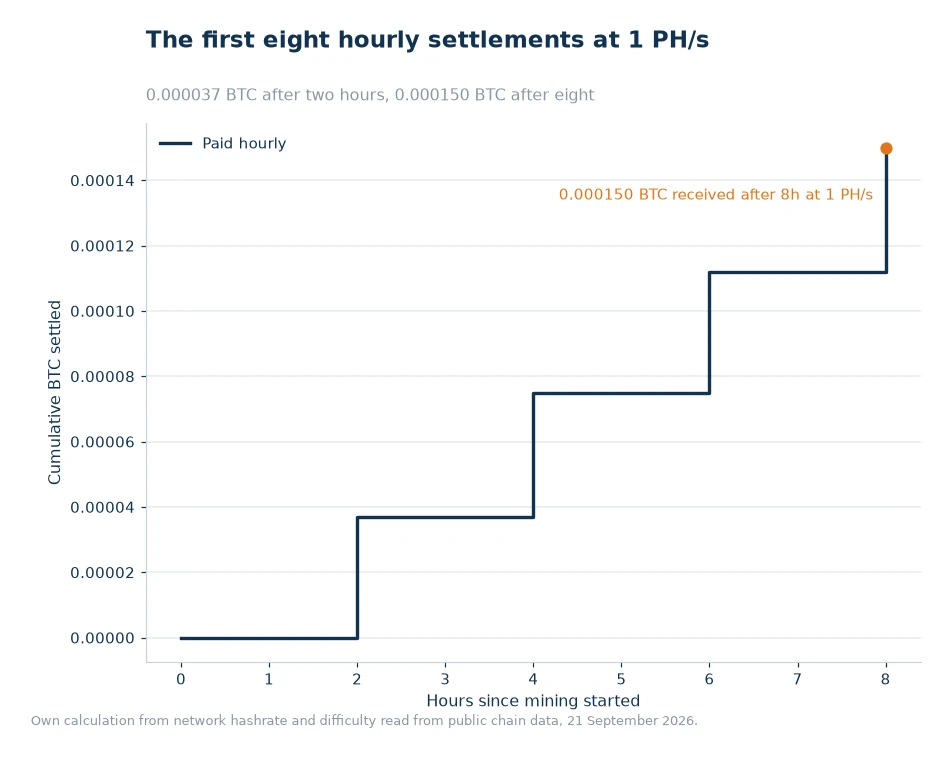
| Hosted contract | 1 PH/s | 0.0004486 | $37.99 | 0.0000187 |
| Combined | 1.7 PH/s | 0.000763 | $64.59 | 0.0000318 |
What changes your payout
Across accounts, four variables decide the month: uptime per site, the payment method on each account, the settlement cadence those methods imply, and whether the withdrawal address on file is still the one you control. The first is a physical problem. The rest are settings, and settings are exactly what gets forgotten when the same operator is juggling three logins.
Fee structure is per account, not per operator
An account that runs PPS+ pays a listed 4% fee on the PPS-settled block-reward component and a listed 2% fee on the transaction-fee component.[1] An account on PPLNS pays a listed 2% fee on both components combined and carries the timing risk itself. If one site is on each method, a single blended fee assumption will be wrong for both.
Uptime differences hide in the aggregate
Site north running at 92% uptime and site south at 99% look identical in a combined daily figure until someone compares them side by side. Because the accounts are independent, the only way to see the gap is to compute expected output per site from its own hashrate and compare it with what was settled.
Worked example: the combined position
Add the three accounts: 200 + 500 + 1,000 TH/s is 1,700 TH/s, or 1.7 PH/s. At 4.486 × 10⁻⁷ BTC per TH/s per day, that is 0.000763 BTC — $64.59 at $84,692 — and 0.0000318 BTC per hour. Over 30 days the combined output is about 0.022879 BTC, or $1,937.64, before the fees applied on each account.
Now price the fragmentation. If site north slips to 92% uptime for a month, its contribution falls from $7.60 to about $6.99 a day, a loss of $0.61 daily — $18.30 over the month — while the combined figure falls only 0.9%, which most operators would never notice without a per-site baseline. Multiplied across three accounts with three different alert configurations, that is how a real fault stays invisible.
Consolidation is the fix, and it is a client-side problem rather than an accounting one. A client that supports multi-account management lets an operator switch between accounts, watch per-worker hashrate and receive alerts without logging in three times: the mobile mining dashboard view is the same instrument whether one account or four sit behind it.
What should not be consolidated is the security boundary. Keep one account per entity or site where that separation matters commercially, and accept that each one needs its own credentials. The ViaBTC App Download ships iOS and Android builds with real-time hashrate monitoring, alerts and multi-account support, so several logins can be held in one authenticated client without merging their balances.
What to check monthly
- Per-site expected versus settled. Recompute each account's expected output from its own hashrate, then compare with what arrived.
- Withdrawal addresses. Check every account, not just the one you use most; an address swap on a dormant login is invisible for months.
- Sessions and devices. Revoke anything unfamiliar, per account.
- 2FA coverage. Enrol it on every account, including the ones you rarely touch.
- Alert routing. Confirm each account's worker alerts reach a phone you carry, and that a per-worker floor exists rather than a single combined total.
- Method drift. Note which accounts run PPS+ and which run PPLNS, so the fee assumption stays correct.
It is also worth aggregating the mining pool side of the picture once a quarter: pool hashrate, network hashrate and difficulty per coin, so you can tell whether a soft month came from your machines or from the network growing faster than your share of it.
Frequently asked questions
Can I mine more than one coin at the same time?
Yes. Merged mining lets a machine secure a parent chain and an auxiliary chain together, and multi-coin pools support switching between chains without moving hardware.
Do mining pools cost anything to join?
Joining is free; the pool earns from its fee on settled payouts, which appears as a percentage of the block-reward and transaction-fee components.
Does one app really manage several mining accounts?
Multi-account management is a documented feature of the mobile client, which supports switching between accounts while keeping hashrate monitoring and alerts in one place. Accounts, credentials and balances remain separate.
Should I merge several accounts into one to save fees?
Fees are applied per settled payout on each account, so merging rarely changes the rate. Merge only if the accounts belong to the same operating entity; otherwise the loss of per-site visibility costs more than any administrative saving.
Build one view, keep the boundaries
List every account you control, along with its hashrate, method and withdrawal address, and put them in one client so a single alert covers the whole operation. Then set a per-site baseline for each account, because a combined total will always hide a 8% slip at one site. Finally, reconcile one month per account against your own arithmetic — the sum of the parts is the only number that is actually yours.
Data and sources: ViaBTC pricing page for the listed PPS+ and PPLNS fee structure and settlement rules[1] and ViaBTC documentation on mobile monitoring and multi-account management[2]. Network difficulty (132.76 T), network hashrate (about 1,003 EH/s), the 3.125 BTC block subsidy and the BTC price of $84,692 were read from public chain data and market feeds on 21 September 2026. Figures are illustrative and change with difficulty and price.