
The job of quality control in luxury fragrance OEM has moved from checking the finished batch to owning the file behind every batch. In the last few years the bar has shifted in five visible ways: standards have become living documents, traceability has moved to the batch level, third-party verification is expected rather than optional, claims must be supported before they print, and the product is judged against the rules of its destination market. For a premium haircare line, where the scent sits on the label and in the marketing, all five changes land directly on the brand.
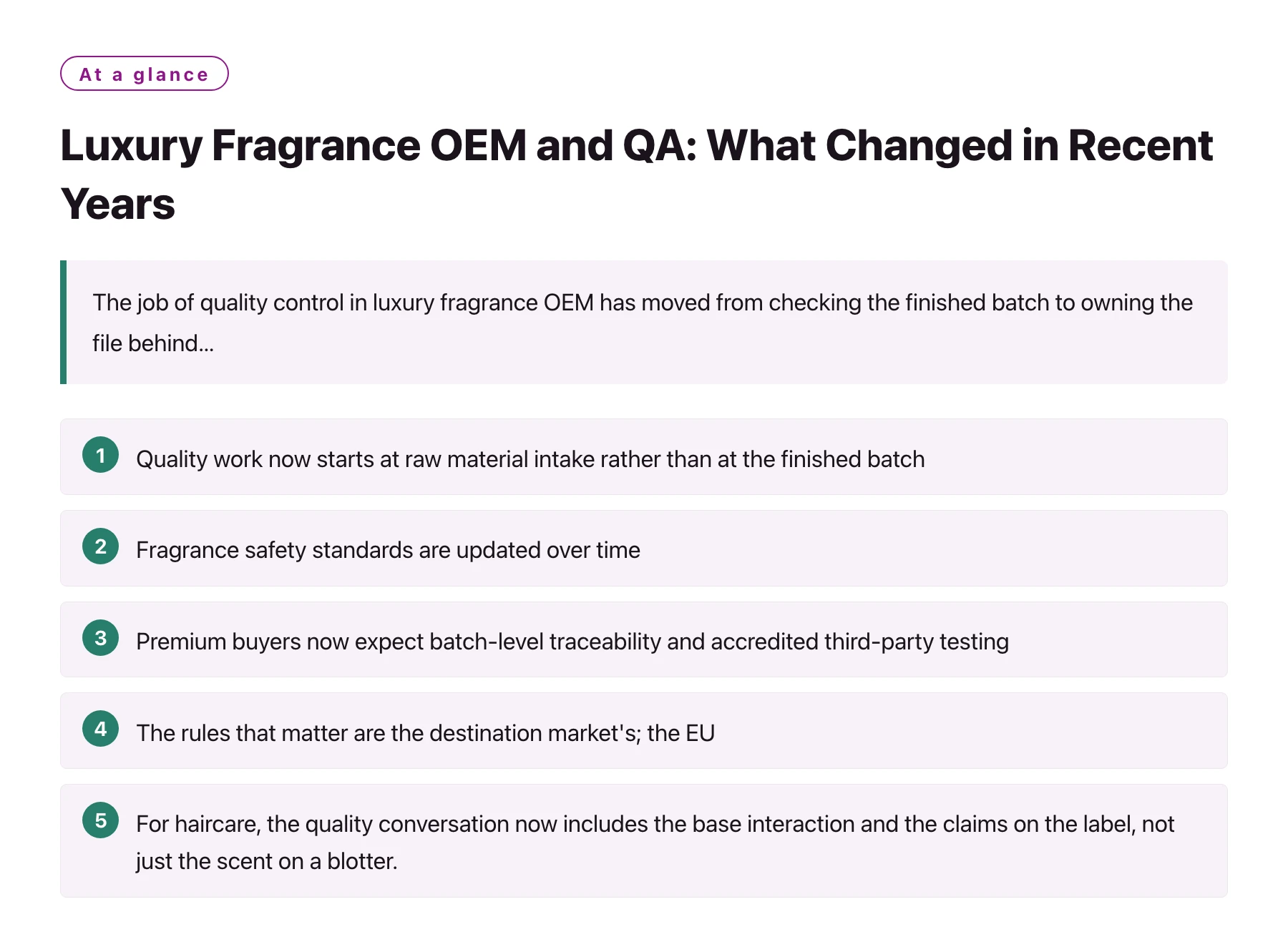
Key takeawaysQuality work now starts at raw material intake rather than at the finished batch, because a premium claim cannot be supported by a late check. · Fragrance safety standards are updated over time; a formulation that passed last year needs re-verification when restrictions change [1]. · Premium buyers now expect batch-level traceability and accredited third-party testing, not a single certificate page [2]. · The rules that matter are the destination market's; the EU, for one, ties compliance duties to the party placing the product on the market [3]. · For haircare, the quality conversation now includes the base interaction and the claims on the label, not just the scent on a blotter.
Ask a veteran perfumer what changed in premium fragrance QA and the answer is not 'more testing'. It is 'testing earlier, documented deeper, and verified by someone other than the person who made it'.
Five changes explain most of the difference between a quality programme from a decade ago and one that a premium buyer expects today. Each one is worth knowing before you audit a supplier or write your own specification.
Quality control then and now
| Area | A classic programme | What premium buyers expect now |
|---|---|---|
| Where QA starts | Finished batch inspection | Raw material intake and formulation review |
| Standards | One certificate page in the file | Living standards library plus batch traceability [1] |
| Verification | The supplier's own laboratory | Supplier plus accredited third parties [2] |
| Documentation | A certificate of analysis | COA, batch record, stability, allergen and ingredient declarations |
| Claims | Marketing wrote them | Claims supported by data before they print |
| Market rules | The factory's country | The markets where the product is sold [3] |
| Haircare flavour | Scent checked on a blotter | Scent checked in the base and after use |
The 'now' column is not perfection; it is the floor. A supplier that still operates on the left column can make a good product — but it cannot carry the file that a premium haircare launch needs.
Why the change happened
Regulation moved to the ingredient level
Restrictions on fragrance materials are maintained as living documents that manufacturers are expected to follow, so a formulation approved years ago is not automatically approved today [1]. At the same time, buyers can check materials directly against official ingredient databases for the EU and other markets, which turns 'trust us' into 'show us the ingredient file' [4].
Retail and e-commerce raised the transparency bar
Store buyers and online platforms now ask for ingredient detail, allergen declarations and safety documentation before a listing goes live. A premium line that cannot answer those questions in writing does not get listed.
Premium haircare made QA a positioning tool
When the fragrance is the selling point of a shampoo or hair mist, quality is marketing. A single batch that smells wrong or separates is not a production incident; it is a brand incident.
What this means for a premium haircare launch
Ask for the file, not the page
The certificate of analysis is one document in the file. Ask to walk through a batch record from raw material intake to release; a supplier that works to a GMP framework will have the record ready, and a supplier that stalls is telling you where its process is weak.
Plan the verification budget
Third-party testing is now a normal line in a premium launch budget, not an optional upgrade. It is the difference between 'our lab says it is fine' and 'an accredited lab verified it'.
Match the QA language to the price
A premium position deserves a partner whose quality language matches. Xuelei publishes a dedicated note on premium fragrance OEM and QA for buyers who want to know what to expect from a production partner, and the guide is a reasonable place to start the conversation. The company behind it — Xuelei on the brand home page — describes itself as a Guangzhou fragrance manufacturer with 31 years of experience, which is the kind of claim to verify on paper rather than on the page.
Extend QA to the format
For a haircare launch, the format extends QA: how the concentrate behaves in the shampoo base, how the bottle interacts with the product, and how the fill survives shipping. A partner whose scope includes fine fragrance work — fine fragrance manufacturing — understands the discipline; the haircare base test is still yours to specify.
The practical rule: whatever the supplier promises, write the file yourself. Batch record, stability data, ingredient declarations, claims backing and the release criteria all belong in a specification the brand owns, because the brand owns the reputation.
Assembling the file that survives a buyer's audit
Start the file at the brief: the product form, the use level, the destination markets and the claims the label will carry. Each subsequent document slots into that frame — the development record, the raw material certificates, the compounding batch record, the stability and compatibility reports, the release certificate and the retained samples.
The file is not finished at the factory door. It travels with the product: importers, retailers and platforms ask for parts of it, and regulators ask for it in an audit. A premium launch that treats the file as a deliverable rather than an archive is the one that answers those requests in hours instead of weeks.
Own the retention policy too: batch records and stability summaries are the documents that defend a product two years after launch, when the first question about a batch arrives.
Sources
- IFRA Standards Library (International Fragrance Association) —— The IFRA Standards Library lists the restrictions the fragrance industry applies to individual fragrance ingredients, based on safety assessments; it is the reference point for compliant fragrance formulation.
- SGS: Cosmetics, Personal Care & Household Testing —— Testing, inspection and certification services for cosmetics and personal care, including microbiological, stability and safety testing aligned with cosmetics GMP.
- Cosmetics Europe —— The European trade association for the cosmetics and personal care industry, publishing guidance, positions and market information.
- EU CosIng — Cosmetic Ingredient Database (European Commission) —— The European Commission's CosIng database of cosmetic ingredients, listing ingredient functions, restrictions and labelling requirements under EU cosmetics law.
Frequently asked questions
Is the QA change driven by regulation or by demand?
Both. Regulation moved compliance duties and standards into living documents, and retail and e-commerce demand made the documentation visible to buyers. Either force alone would have changed the work; together they redefined it.
Do I need third-party testing for every batch?
For a premium launch, plan accredited testing for the development and at defined intervals, and batch-level records in between. The pattern depends on your market and claims; what is not negotiable is that someone independent checks the repeatability.
What exactly is a batch record?
The run-by-run document showing what was made: materials, weights, timings, equipment, and any deviations and their disposition. It is the evidence that the batch actually matches the specification.
How do I verify that a certificate is current?
Ask for the certificate number, the issuing body, the scope and the validity date, then confirm with the issuer. A certificate list is the opening of a conversation, not the conclusion of one.
Where does a premium haircare brand start?
At the brief-level file: write the specification that names the product forms, markets and claims first. Everything else — the supplier's programme, the third-party tests, the batch records — is measured against that specification.